

Interestingly enough, I finished my internship at the same site I started The Huntington at King Farm. Being at the Huntington again got me to reflect on my experiences with Ruppert.
I started my internship thirteen weeks ago and it was remarkable to me how much I learned in that short time. I was fortunate enough to get experience in landscape maintenance, landscape construction, management training, as well as design proposals and contracts.

King Farm Site Plan (source)
The first three weeks of my internship were spent with the enhancement department. Being early summer we were very busy with seasonal color rotations. One job in particular sticks out in my mind from the first three weeks, the Friendship Heights Village Center and Friendship Park. Friendship Heights, an affluent suburb of Washington DC, had contracted over forty thousand dollars worth of seasonal color for their urban parks. There were so many perennial to install that they had to be delivered in two full semi trailers. With over twenty people working it took us over twelve hours to install all the perennials. However, the final product was really impressive and our client was pleased. What I took away from that enhancement project and the first three weeks in general was that a successful company will do everything in their power to make their costumers happy. Ruppert prides itself on costumer service believes it is the foundation for its success.

Friendship Heights Village Center (source)
The next distinct portion of my internship was spent in new field manager orientation. The orientation focused on management skills such as hiring the right employees, how to be efficient, as well as different managerial styles. Each topic was related back to Ruppert's values which form the way the company operates. There were several values but the most important was 'Ruppert's number one asset is its people.' This means that Ruppert believes in its employees and when they hire they intend to hire for life. By empowering their employees, the company believes that will be more dedicated and efficient. It was really easy to see the value in effect everyday at Ruppert because I could tell the employees really believed in where they work. This made me realize that when I graduate I want to work for a company that shares the same key value.
Also during my internship I had the opportunity to attend a monthly branch manager's meeting. This meeting focused on each branch and how they were tracking towards their projected budget. The financial information was incredibly rewarding to participate in, but overwhelming at the same time. Having no background in finance, I was not able to follow the discussions when they got technical, but the information I was able to absorb was really eye opening.
The most valuable time of my internship was spent in the landscape construction department. The landscape construction department specializes in high-quality, technically-challenging and large-scale commercial landscape construction. The division offers estimating and pre-construction services, general installation services, and project management services. I spent my time with the installation division working at the Wounded Warrior Transition Unit at Bethesda Naval Hospital. The site was in it's final week of construction and all the contractors were in a rush to meet the details. Ruppert was contracted by Whiting-Turner to install hardscape, retaining walls, as well as all the plant material for the site. I had the opportunity to supervise and participate in a couple different installations including the construction of a dry riverbed, a permeable grass-paver road, site grading, and plant installation.
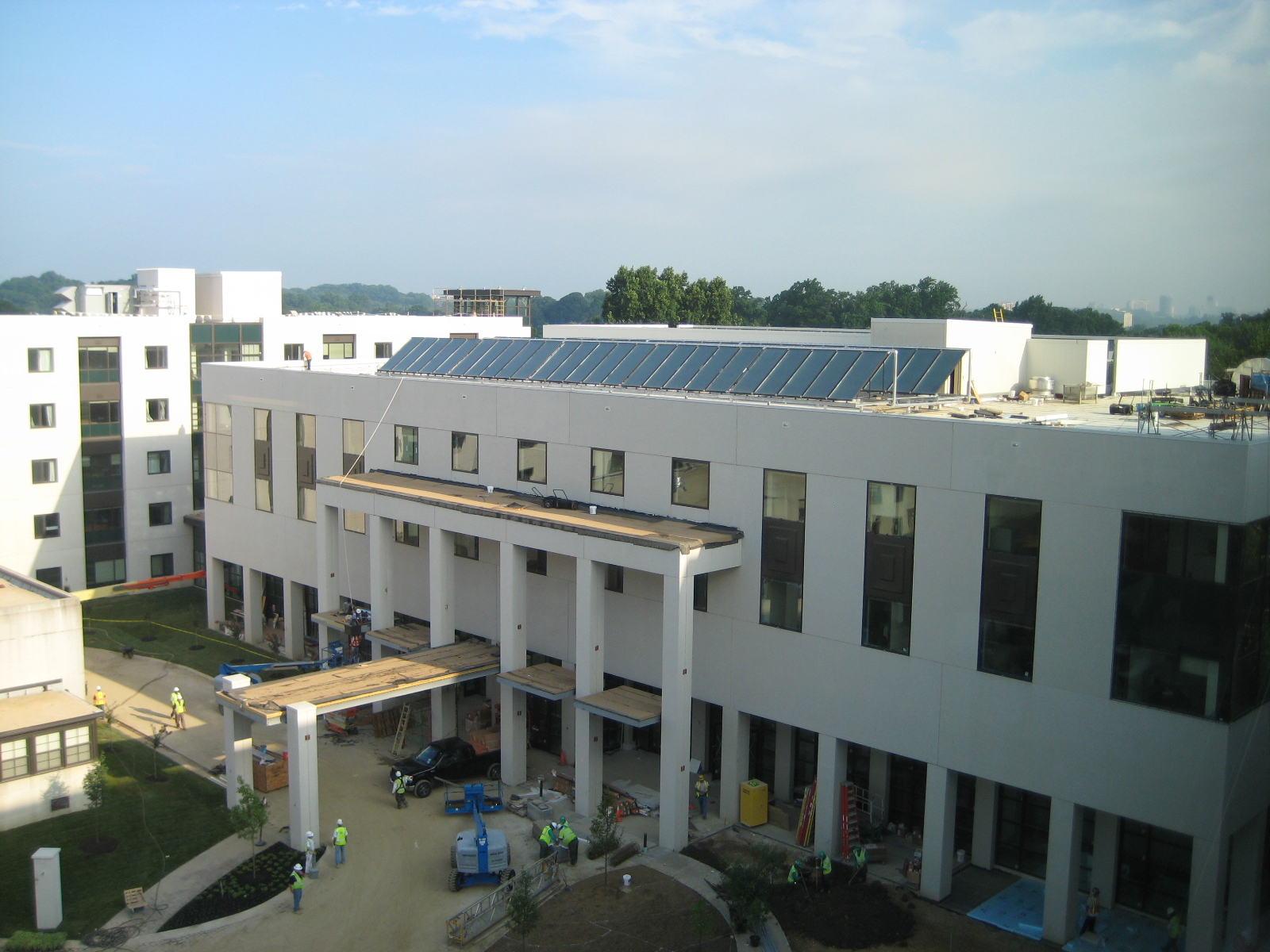
Wounded Warrior Transition Unit (source)
The plant schedule for this project was vast and took preparation for each species to be delivered to the right location at an appropriate time to ensure no conflicts with other contractors. To ensure that we were accurate to the construction documents I was placed in charge of marking off installed plant species and documenting the plant material we still needed to purchase.

Aerial View (source)
I also had the opportunity to learn how to use heavy construction machinery while on the job. I used a ride-on trenching machine while installing a plastic liner for a sidewalk. I also operated a roller compacter to level and grade a road through the site. The site forman even taught me to use a self-leveling transit to take spot elevations for the road we were installing.

Perspective (source)
Another valuable experience during my internship was spent creating a design proposal for the enhancement department. The proposal was for The Kenmore Apartments located on Connecticut Avenue in Washington DC. I assisted Ruppert's Landscape Architect during the process of creating a new planting design for a bed in the parking lot behind the apartment tower. I worked with him through the entire design process starting with a site visit and and ending with a job package.
The first step of the process was to visit the site and inventory and analyze the site conditions as well record site measurements. From the site measurements we were able to draft a design proposal (I created the presentation graphic below for the design). We then entered the plant quantities, determined during the design phase, into Ruppert's estimating system and were able to come up with a price and target percent profit for the particular design. After looking over the estimating sheet I wrote up a proposal to send to the client that highlighted the work we would be contracted for and how much it would cost. Unfortunately, the client decided to hold off on the design until later in the year but I hope that the design will go ahead by the time I get back to school.

Presentation Graphic © Ruppert Landscape 2011
Ruppert was gracious enough to hold a closing ceremony for the interns in St. Michaels, Maryland. The day started with great presentations from the leaders of the company. They provided great leadership and career advice that I will hang on to for the rest of my career. After hearing from the Ruppert leadership it was time for each intern to give his/her presentation on their experience with the company. My presentation was on the enhancement proposal I did for the Kenmore Apartments. Each intern did an excellent job presenting and there were a lot of great comments and questions for each presenter.

Chesapeake Country (source)
I was the final presentation before we headed up the Miles River to the Crab Claw for lunch. The Crab Claw is located on the waterfront in St. Michaels and is one of the few multiple story buildings in town. We were seated on the second floor which provided an amazing view of the surrounding bay landscape. I was amazed because Ruppert had arranged for us to have a crab and seafood feast. There was steamed shrimp, eastern shore fried chicken, mussels, oysters, and steamed crabs for everyone to try. For my meal I had the best soft shell crab sandwich I have ever tasted. What a great uniquely Maryland restaurant.
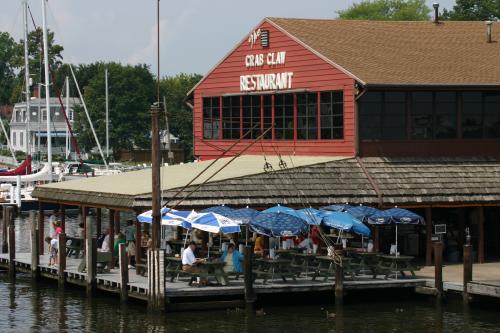
The Cracked Claw (source)
On the way back we anchored the boat and decided to take a swim in the middle of the miles river. The boat worked as a nice diving platform and we spent the good part of an hour swimming around the boat. It was a great way to finish an amazing internship and a wonderful intern day.
My internship with Ruppert was tough but rewarding. Long days and and early mornings quickly became my routine. I am finishing my internship with several new skills and a new perspective on the landscape industry. I would be happy to work for Ruppert Landscape in the future and will be referring my friends to look into the internship program for next summer. I want to thank everyone at Ruppert for allowing me to work with them. In particular Mike Lora, Kevin Wetzonis, Pat Cunningham, Jack Ruppert, Bill Angelis, and Ed O'Brian were instrumental in my success at Ruppert. Also I need to thank Craig Ruppert, Chris Davitt, Jay Long, and Phil Key for providing invaluable advice and going above and beyond for the interns. Thank you.


